

Introduction
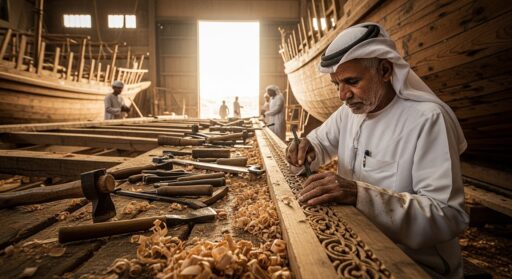
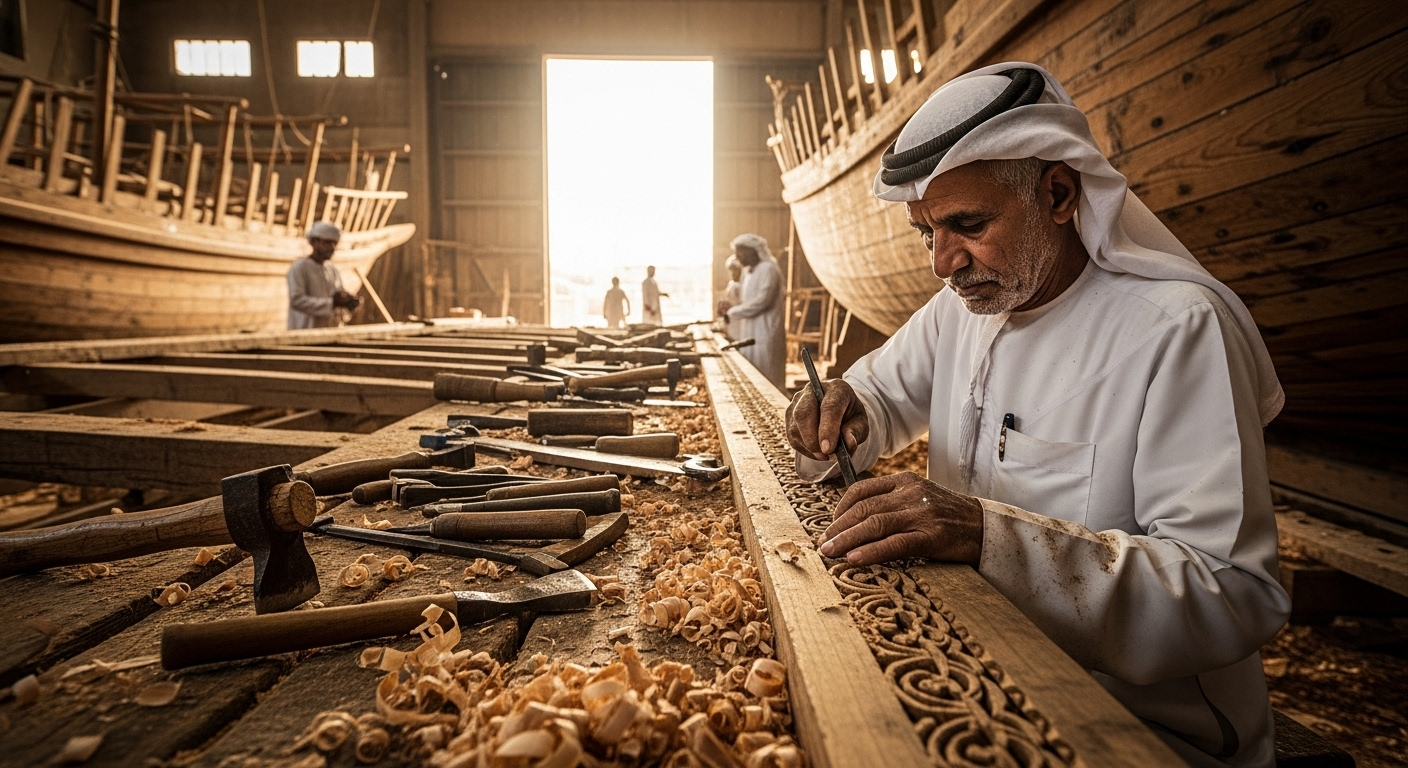
For centuries, the silhouette of the dhow has been the defining image of the Arabian Gulf. These elegant wooden sailing vessels were the lifeblood of the region, carrying traders, pearl divers, and explorers across the Indian Ocean, linking the UAE to a vast maritime world. The creation of a dhow was not an act of simple carpentry but a high art form, passed down through generations of master craftsmen, or ustas. Devoid of formal blueprints, the design lived in the memory and skilled hands of the builder. This article delves into the intimate world of the dhow builder, a vanishing skill that represents a profound chapter in the UAE’s identity as a seafaring nation.
History
The history of dhow building in the UAE is as old as its coastal settlements. Shipyards, known as gallayat, once thrived in coastal towns like Dubai, Ras Al Khaimah, and Umm Al Quwain. The craft peaked during the boom years of the pearling industry in the late 19th and early 20th centuries, when a fleet of thousands of dhows was needed. The collapse of the pearling industry in the 1930s was a devastating blow, from which the craft never fully recovered. The subsequent discovery of oil shifted the economic focus away from the sea, and the advent of modern, steel-hulled ships rendered the commercial construction of wooden dhows largely obsolete.
Key Features
The traditional dhow-building process was a masterpiece of intuitive engineering:
- Design by Eye and Experience: The usta worked without detailed plans. The vessel’s lines and dimensions existed in his head, guided by proportional rules and a deep, inherited understanding of hydrodynamics and sail dynamics.
- The “Shell-First” Method: Unlike Western shipbuilding which uses a rigid internal frame, dhows were built “shell-first.” The hull was constructed by first laying the planks and then reinforcing them with internal frames. This required incredible precision to ensure the hull was watertight and symmetrical.
- Specialized Woods: Builders sourced specific woods for different parts of the vessel. Teak from India was prized for its durability and resistance to rot, while acacia (samr) from local mountains was used for the frames and pegs.
- Natural Materials: The planks were sewn together or fastened with wooden pegs before the widespread use of nails. The seams were caulked with cotton fibers soaked in shark liver or sesame oil, which would swell upon contact with water, creating a perfect seal.
Cultural Significance
The dhow yard was more than a workplace; it was a community hub and a center of knowledge transfer. The usta was a highly respected figure, and his apprenticeship system was the primary way the craft survived. The launch of a new dhow was a major community celebration, marked by ceremonies and prayers for its safe voyages. The dhow itself was a symbol of collective endeavor—it represented the capital of the merchant, the skill of the builder, and the courage of the sailors. It embodied the Emirati traits of trade, exploration, and resilience in the face of the treacherous sea.
Modern Relevance
Today, the number of master dhow builders who learned the craft in its traditional context can be counted on one hand. The skill is critically endangered. However, there is a renewed appreciation for its cultural value. The UAE government sponsors the restoration of historic dhows, which are displayed in museums like the Dubai Museum and the Sharjah Maritime Museum. A handful of yards still operate, primarily building smaller, motorized dhows for tourism and fishing, often using a hybrid of traditional and modern methods. The most significant modern relevance lies in the dhow’s powerful symbolism. The logo of the ports of Dubai, Jebel Ali, is a dhow, a conscious nod to the maritime heritage that underpins its modern success as a global trading hub.
Conclusion
The dhow builder’s craft is a poignant symbol of a bygone era. The silent gallayat stand in stark contrast to the bustling modern ports, yet the spirit of the dhow is everywhere. It is a reminder that long before container ships, it was these graceful wooden vessels that established the UAE’s connection to the world. Preserving the knowledge of the usta is not just about saving a craft; it is about honoring the memory of the sailors and builders who, with simple tools and profound wisdom, navigated the oceans and laid the foundations for the global crossroads the UAE is today.