

Introduction
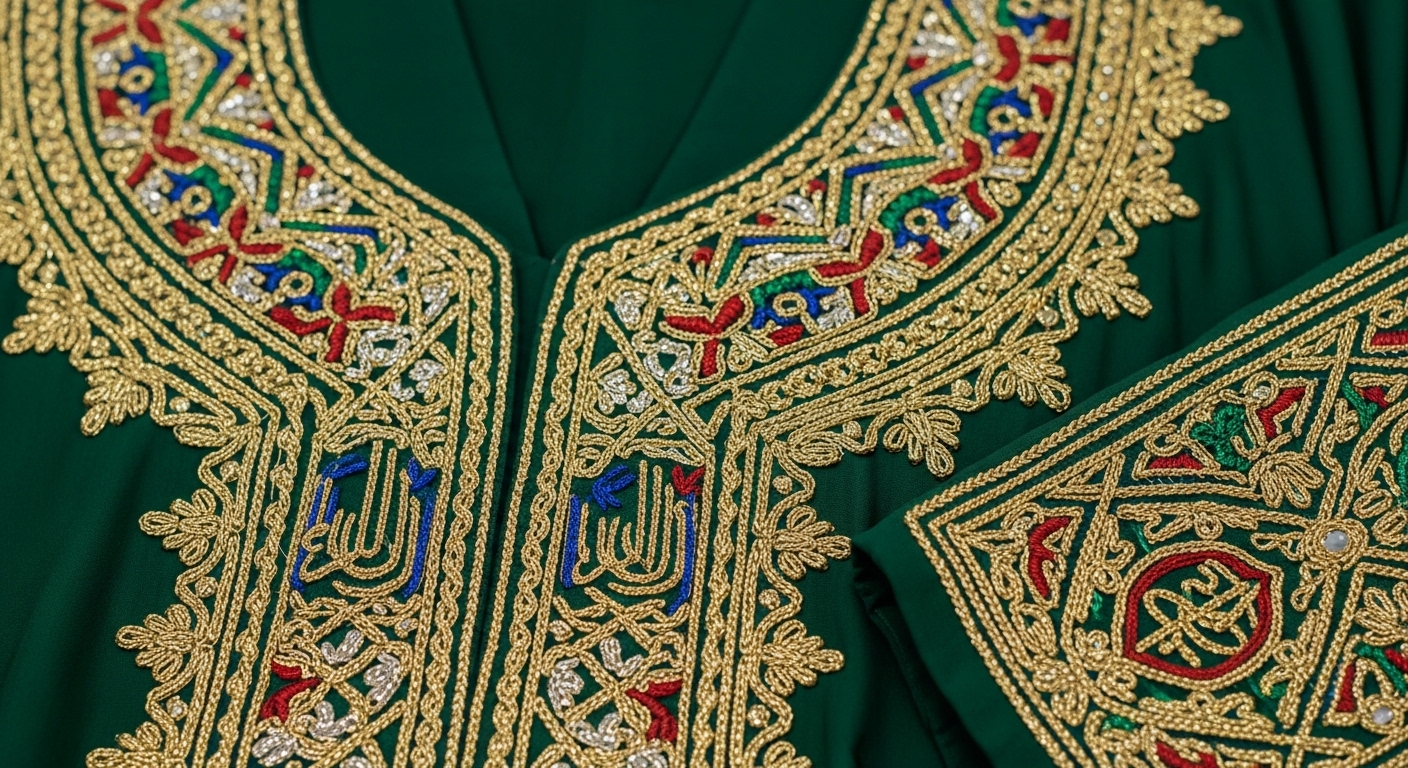
In the realm of Emirati traditional crafts, where Al Sadu speaks with bold, geometric patterns, Talli whispers with intricate, delicate complexity. Talli is the exquisite form of hand-embroidery used to adorn the cuffs, chest panel, and hem of the traditional Emirati woman’s dress, the kandura or thobe. Often using metallic threads, it transforms a simple garment into a masterpiece of wearable art. More than just decoration, Talli is a language of femininity, identity, and social status, its patterns and quality speaking volumes about the wearer’s family and regional origin. This craft represents the pinnacle of patience and precision in Emirati folk art.
History
The history of Talli is deeply intertwined with the social history of Emirati women. It was a craft practiced in the home, a key skill for a young woman to master. Before the oil era, the materials used were often sourced from trade: fine silk and cotton threads, and later, silver and gold metallic threads (qasab) that were imported from India and other regions. The preparation of a bride’s trousseau always included several thobes embellished with the most elaborate and time-consuming Talli work, showcasing her skill and her family’s wealth. It was a primary form of artistic expression for women in a more secluded society, a way to display beauty and creativity within cultural norms.
Key Features
Talli is defined by its technique, materials, and symbolic patterns:
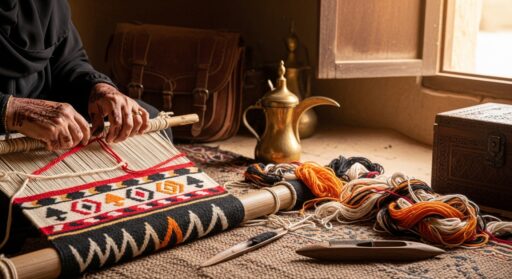
- The Technique: The base of the embroidery is a loom, but unlike the large ground loom for Sadu, the Talli loom (noujooq) is a small, handheld wooden frame. The warp threads are stretched on this frame, and the embroidery is created by weaving and braiding the weft threads in complex patterns using a needle.
- The Six Threads: The foundation of most Talli work involves six primary threads, which are braided and woven to create the central pattern. Additional threads and beads are often incorporated for greater complexity and shine.
- Intricate Patterns and Motifs: Talli designs are rich with symbolism. Common patterns have names like Umm al- Khous (mother of the palm frond), Al Rasha (the feathers), and Al Hayyah (the snake), each with its own story and aesthetic.
- Materials: Traditional Talli uses silk, cotton, and metallic threads. It is often further embellished with delicate beads, sequins, and farsi (a coiled silver wire), catching the light with every movement.
Cultural Significance
Talli was a powerful, non-verbal form of communication for Emirati women. The quality, complexity, and style of the Talli on a woman’s dress could indicate her marital status, her tribal affiliation, and even the region she was from. It was a cherished heirloom, with mothers passing down specially embroidered dresses to their daughters. The act of creating Talli was also a social one; women would gather in groups to work, sharing patterns, stories, and companionship. In a society where public display was modest, Talli allowed for a vibrant and sophisticated expression of personal and cultural identity.
Modern Relevance
While modern fashion has introduced simpler, machine-embroidered alternatives, the art of handcrafted Talli is being vigorously preserved. It is a central feature at heritage festivals and is promoted by cultural organizations as a key element of national identity. Master craftswomen, often elderly, are recognized as living treasures, and efforts are underway to document their knowledge and teach younger generations through workshops and formal programs. Contemporary Emirati designers are also reinterpreting Talli, using its motifs in modern fashion and accessories, ensuring its relevance for a new generation. For many Emirati women, wearing a thobe with handmade Talli on national occasions is a profound source of pride and a direct link to their grandmothers’ legacy.
Conclusion
Talli is the delicate silver and gold thread that stitches the past to the present. It is a testament to the patience, artistry, and rich inner world of Emirati women throughout history. In its intricate loops and braids, one can read stories of courtship, community, and cultural pride. As the UAE continues to modernize at a breathtaking pace, the survival of Talli signifies a commitment to preserving the subtle, beautiful nuances of its heritage, ensuring that this elegant language of thread continues to be spoken for generations to come.