

Introduction
In the pre-oil UAE, where every resource was precious, the date palm (nakhl) was rightly known as the “tree of life.” It provided food, shade, and building materials. From its fronds (khoos) emerged one of the most ubiquitous and vital crafts: the art of weaving palm fronds. This craft, known simply as khoos, transformed the humble leaf into a vast array of functional items that were essential for daily life. From storage containers and fishing traps to mats and fans, khoos products were a testament to the Emirati principle of zero waste and the ability to create sophisticated utility from the simplest of natural materials.
History
The craft of khoos is ancient, dating back to the earliest agricultural settlements in the region. Nearly every family living in the oases or coastal areas had someone, often the older women and men, who was skilled in the basic techniques of palm frond weaving. It was a domestic craft, not a specialized trade, born out of immediate necessity. The raw material was abundant and free. After the date harvest, the fronds were collected, dried, and then prepared for weaving. The knowledge was passed down informally, from parent to child, ensuring that every generation could produce the containers, mats, and other items needed for their home and work.
Key Features
The khoos craft is characterized by its simplicity, functionality, and regional variation:
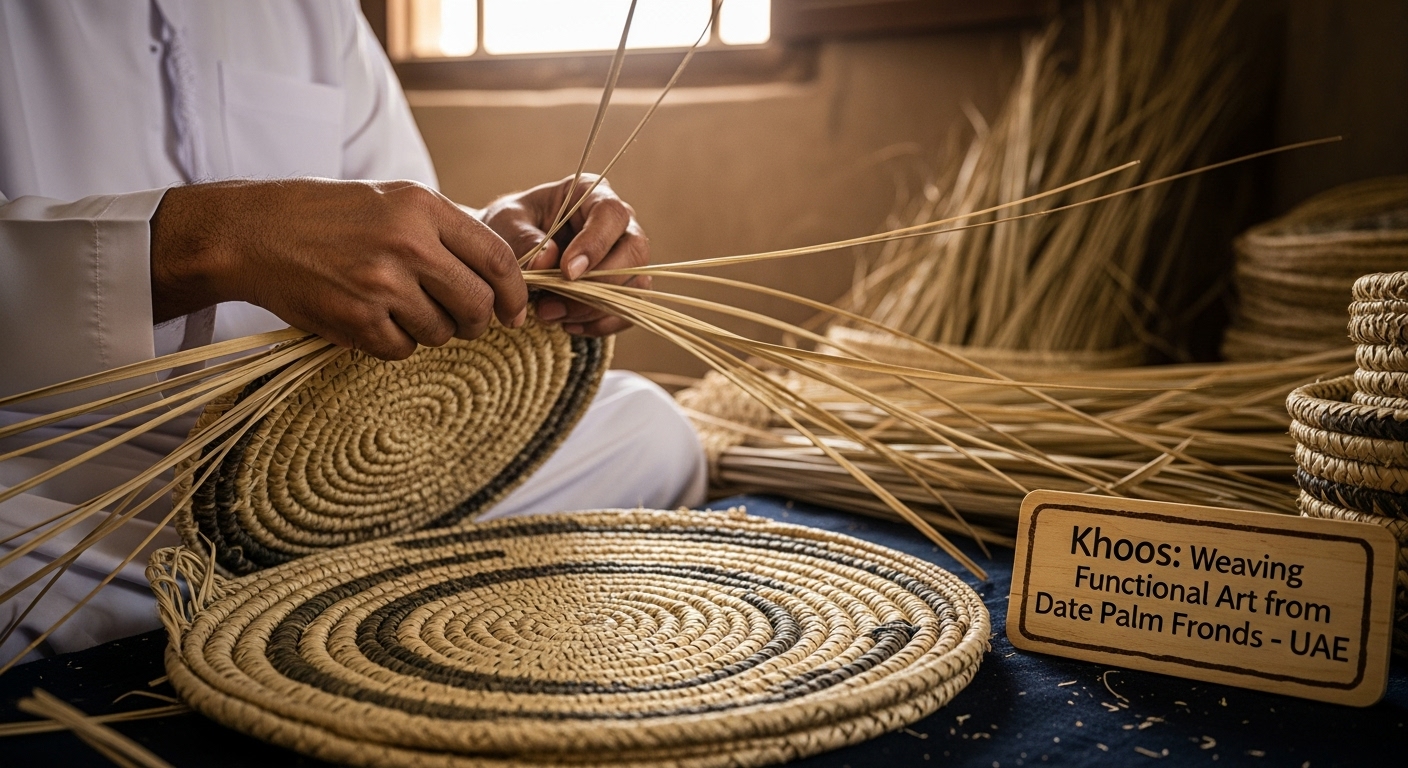
- Material Preparation: The fronds are first dried and then the central spine (arees) is removed. The leaves are often split into finer strands depending on the item being made. Sometimes they were soaked to make them more pliable for weaving.
- Weaving Techniques: The primary techniques involved simple plaiting and twining to create flat sheets for mats (hasseer) or more complex three-dimensional shapes for baskets and traps.
- Functional Products: The range of items produced was extensive. It included: makhbaza (food covers), matr (large storage baskets), gafa’ah (open baskets for carrying dates or fish), quffah (fishing traps), and fans (mahaffa).
- Regional Styles: The designs and primary products could vary. In agricultural areas, baskets for dates were common, while in coastal communities, fish traps and mats for drying fish were more prevalent.
Cultural Significance
Khoos was the epitome of sustainable living and practical ingenuity. It represented a deep, symbiotic relationship with the local environment. The craft required no financial investment, only skill and time, making it accessible to everyone, regardless of wealth. The products of khoos were integral to the rhythm of daily life—the mat for sleeping and praying, the basket for carrying the harvest, the cover for protecting food. It was a craft that fostered self-sufficiency and reflected a communal way of life where knowledge was shared for the benefit of all.
Modern Relevance
In the modern UAE, the practical need for khoos items has almost entirely disappeared, replaced by plastic and metal alternatives. However, the craft is experiencing a revival as a powerful symbol of heritage and sustainability. It is a staple at heritage villages and cultural workshops, where visitors can see demonstrations and try their hand at basic weaving. Contemporary artisans and designers are reimagining khoos, creating decorative items, lampshades, and modern home accessories that blend traditional techniques with contemporary aesthetics. This not only preserves the skill but also gives it a new economic viability. In an age of environmental awareness, khoos serves as a timeless lesson in resourcefulness and circular economy.
Conclusion
The craft of khoos may seem humble compared to the glittering jewels of modern UAE, but its cultural value is immense. It is a direct link to a time when life was dictated by the rhythms of nature and survival depended on skill and wisdom. The woven palm frond is a symbol of resilience, simplicity, and profound respect for the natural world. By preserving and celebrating khoos, the UAE honors not just a craft, but the very ethos of its ancestors—an ethos of making the most of what you have, and finding beauty and utility in the simplest of things.